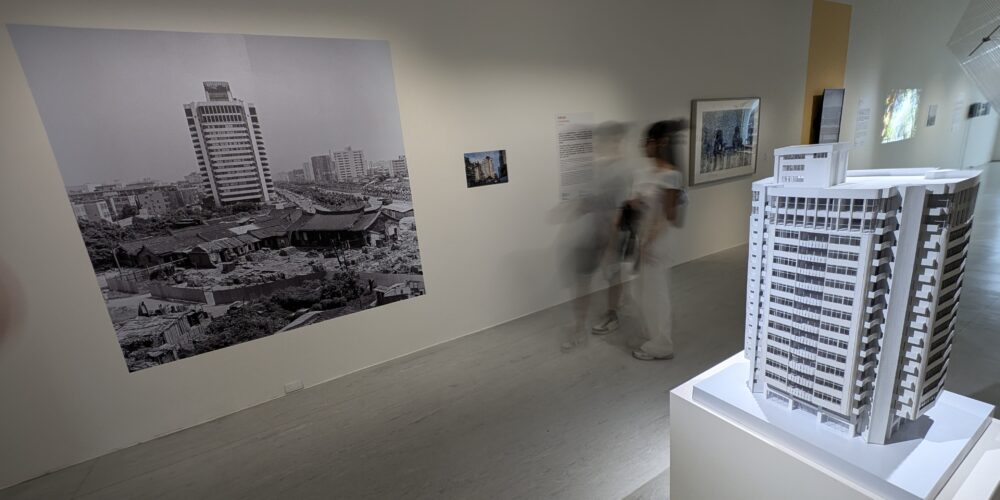
This weekend we went to TFAM to see an exhibit surveying the history of Taiwan architecture: “MODERN LIFE :TAIWAN ARCHITECTURE 1949-1983.” We also saw the two other exhibits on display, one a South African artist named William Kentridge and the other a Taiwanese artist named Hsu Yu-Jen.
Here’s Hsu’s biography from the museum:
Hsu Yu-Jen (1951-) was born in Jiali, Tainan County. After graduating from Tainan Second Senior High School in 1972, he studied in the Chinese painting division of the National Taiwan Academy of Arts fine arts department. Graduating in 1975, he then performed military service on Kinmen island. This was toward the end of the Second Taiwan Strait Crisis, when China was bombarding Kinmen on odd-numbered calendar days, then resting on even-numbered days.
The loss of life all around him led Hsu to ponder the importance of living and existence. He studied under prominent Taiwanese modernist Lee Chun-Shan, who inspired him to pursue creative freedom and self-exploration. After holding his own solo exhibition at the American Cultural Center in Taipei in 1979, he moved back and forth between the United States and Taiwan three times within ten years. The experience of living in a foreign land gave Hsu a deep sense that his art should grow and develop on his native soil, so he made up his mind to return permanently to Taiwan with his family in 1989. He has worked in a variety of media, including ink, oil, and mixed-media painting, and in his early years he also sculpted stone. Yet while his art is not limited by material or category, throughout his many explorations he has never ceased to investigate the essence of ink and new forms of expression with the brush. Painting in ink with a contemporary outlook, he seeks to resonate with both the contemporary and the traditional.
The center of Hsu Yu-Jen’s art has gradually shifted over the course of his career, from an initial focus on his own life experiences, to the dramatic changes in Taiwanese society in the 1990s under the influence of industrialization and urbanization, to his “Ocean” series beginning in 2000, to a long-term consideration of creative perspectives on ink painting Since 2007, he has established his own a personal style, releasing his “Fine Brush” and “Rough Brush” painting series and developing his unique “Fine Brush Broken Line” brushwork method, with spatial compositions featuring a preponderance of blank space. In his works, we continually see his love for nature and plants and his keen sensitivity to his land and people. He straightforwardly and sincerely depicts his personal understanding of he changing environment, of gathering and parting, and of impermanence. Through his art he tirelessly engages in a dialogue with the essence of painting.
This exhibition is anchored on the four Chinese characters for “Drowning,” “Floating,” “Sinking,” and “Eddying,” which are independent yet interconnect and extend from one another. They convey the obsessive passion that HsuYu-Jen feels for art, demanding of himself that he immerse himself in it and delve into its essence. These words are filled with dynamic imaginative images of suspension and submersion in water, reflecting the artist’s penchant for swimming amidst the experiences of life with all its vicissitudes, and his unextinguishable enthusiasm for creativity.
Looking back on Hsu Yu-Jen’s five decades of artistic exploration, this exhibition systematically presents his works and notes, including more than 300 drawings and paintings in ink, oil, and mixed-media from 1972 to today. To faithfully portray the artist’s own creative views and methods, the exhibition also features manuscripts, notes,painting tools, and documentary films with interviews. It is organized according to seven themes, reflecting his creative evolution and personal spirit: “From Jiali to Taipei, from Taipei to New York”, “Who Really Understands Nature?”, “Self-portraits in Piles of Stones,” “Limitless Landscapes,” “Points-the Birthplace of Breakpoints and Dottedi Lines,” “Explorations in Ink and Color,” and “Slowness and Serenity.”
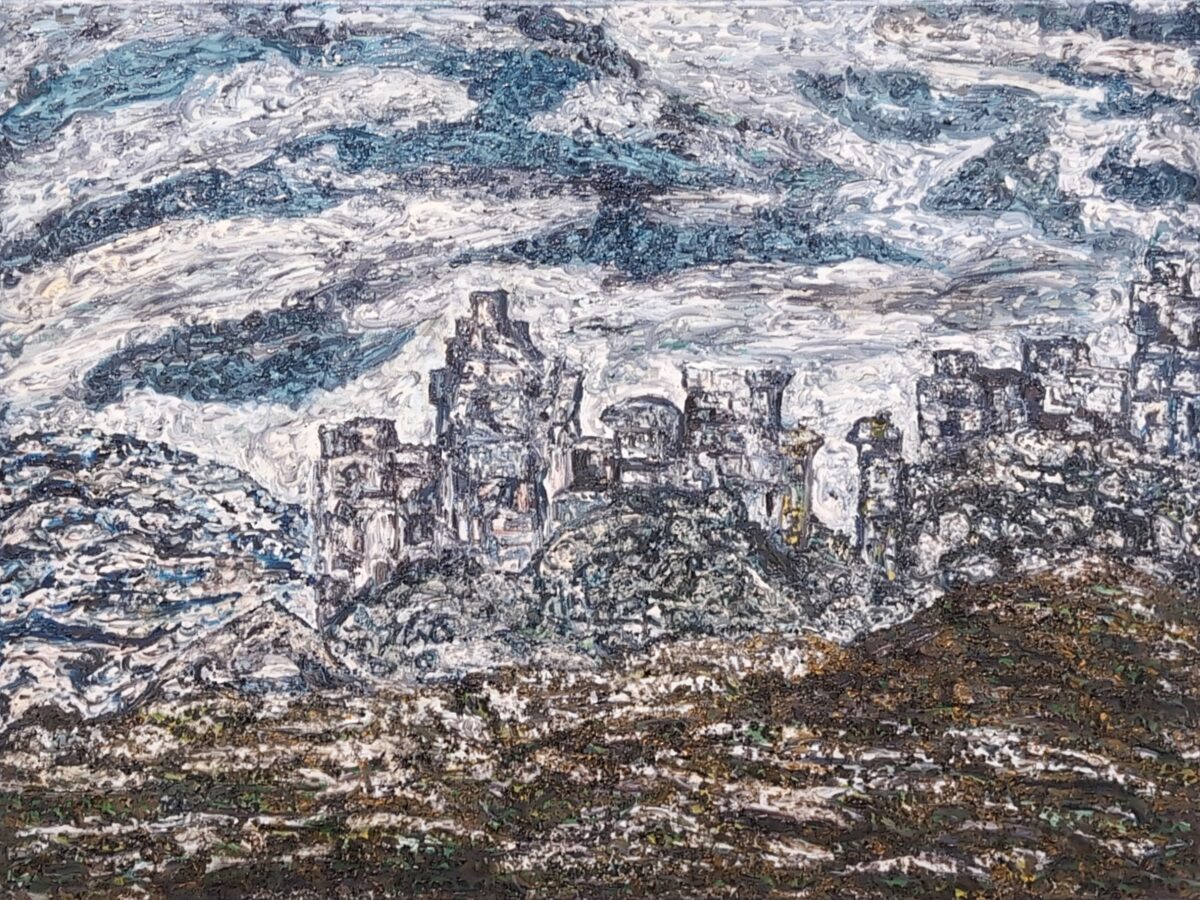
This was probably my favorite painting of Hsu’s, an oil on canvas from 1993 titled Concrete Landscape, which powerfully captures the urban Taiwan vibe.
Being in Taiwan means, quite literally, living inside its architecture. The experience of the island—how it feels, how it looks—is inseparable from the spaces its buildings create. With few exceptions, Taiwan’s built environment produces an immediate and unmistakable sense of place: wherever you are, it is inescapably apparent that you are in Taiwan. The feeling of Taiwanness is not merely cultural or symbolic; it is constructed through the lived, bodily experience of space itself, in ways that ultimately exceed what language can fully capture.
