Those of us who take up the duty to reflect honestly and turn the microscope on domestic public affairs can often miss the forest for the trees. Sometimes it takes a longer lens to squash the fuller cultural image into frame, and it takes the subtle shifts of everyday practice between a new place and home to pronounce the differences. Consequently, few things make clearer your own cultural assumptions than traveling abroad.
An odd part of doing a two week quarantine after flying across an ocean to be in a new place is the simultaneity of newness and sameness. I know intellectually, and sense viscerally, that I am in a new place: the humidity and birdsongs are foreign; the view of lush subtropical mountainsides behind the sturdy brutalism of the city’s architecture remind me nothing-at-all of home.
But I remain confined in the same space, day after day, still surrounded only by my own same personal belongings, my inner monologue still flowing in the same language and interrupted only by distant echoes of any foreign tongues. The same electronic devices remain full of the same noise I’m used to seeing day-to-day at home.
Google Translate even stanches the threat to confront exotic information online, seamlessly transliterating the traditional Chinese characters on the local telecom websites into completely comprehensible English, as I frantically browse the selection of upgrades to the sluggish bandwidth on the prepaid SIM card I was forced to purchase at the airport.
This latter convenience is old news by now. We’ve all become somewhat accustomed to technology making our lives easier. As it ever more efficiently predicts our wants and needs—God forbid any of us experience any analog discomfort—we’ve even begun to feel entitled to its efficiencies: entitled to faster Internet; entitled to instant access to everything “at the right place, at the right time;” entitled, in general, all at once to the whole world being available to us in one or two clicks; but perhaps most of all, entitled to our entitlement.
It’s a part of our identity that is betrayed everywhere Americans have to wait for something—and my own current frustration with my mobile data plan reminds me I’m not immune to this inherited gene. The inevitable huffing, puffing and groaning so many Americans manufacture when waiting in line at the grocery store, or in traffic, or when folding back and forth between the retractable belts at the TSA security check: anywhere and everywhere, each of us a method actor with a deep resource of preconceived insult, every moment of delay a new opportunity for performative exasperation at an imaginary personal offense, our lines and blocking rehearsed to the point of high theatre, ready to be released at the slightest hint of inconvenience, that the world would dare to make us wait.
Despite the fact that Americans have managed to tie disaffected “coolness” to the national brand, it is these tiny interstitial moments that give us a peak at the truths that lie underneath, these small tells revealing that hiding beneath our characteristic aplomb is a repressed anxiety—about what, exactly, we still have no-fucking-clue. To be sure, we keep the rage bottled up deep inside and move along pretending everything is fine; because while our disdain for inefficiency is in our cultural DNA, it is at most a subtextual mark of American identity, not something we would ever discuss openly for more than a moment, and even then only as a matter of “small talk.”
Those of us who take up the duty to reflect honestly and turn the microscope on domestic public affairs can often miss the forest for the trees. Sometimes it takes a longer lens to squash the fuller cultural image into frame, and it takes the subtle shifts of everyday practice between a new place and home to pronounce the differences. Consequently, few things make clearer your own cultural assumptions than traveling abroad.
As subtle differences go, there are plenty to be found in the Taiwanese cultural logic. But for all the invisible mores, there are differences to notice in Taiwan that are quite stark.
One of the more peculiar things an American living here will experience is the civil design of the waste management system. And as quarantine dictates that I am only, if temporarily, able to experience my new home through a bedroom window, this particularity is one of the few cultural differences that stands out to be worthy of observation so far during my stay.
Every other day or so, out my window I can hear the familiar tune of what any American would assume was an ice cream truck. Beethoven’s Für Elise, playing in the distinct chirp of a musical car horn, is one of a handful of songs that punctuate the summertime of American childhood.
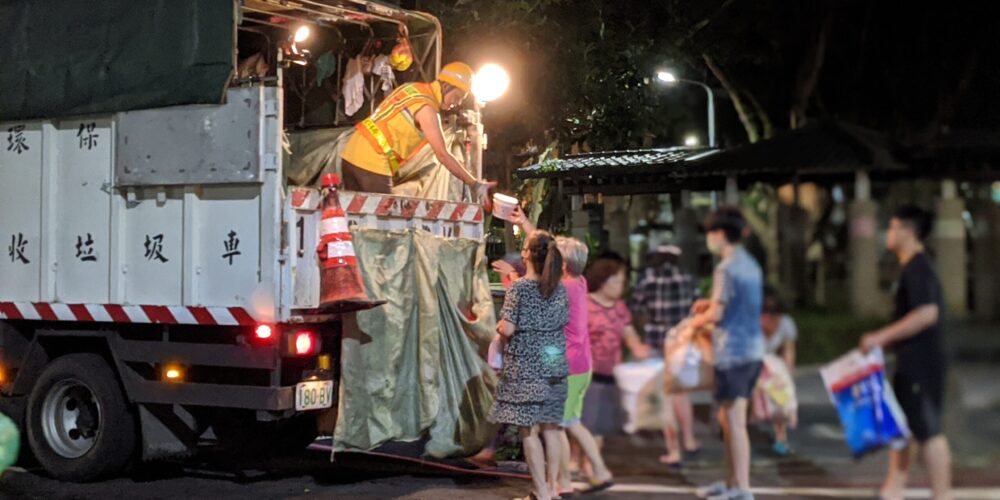
The siren blaring louder, it was not until later that I learned that this evening musical interlude was not, sadly, a daily visit from a friendly neighborhood purveyor of frozen desserts. Instead, this was the beckoning of the waste management truck, calling the denizens down from densely populated Taipei, a designated family member toting trash in hand—where each individual household is responsible to properly sort and deposit their waste into the requisite truck load.
Immediately at the thought of such a thing, a conclusion jumped to my American mind: yikes, this is so inconvenient! What strange backwardness is this?
Later, as the protocol was further detailed, my puzzlement at the inefficiency waned. A younger version of myself, and an earlier American, would have scoffed at the sheer waste of man hours lost in this enterprise, seemingly enough labor to build and sustain titans of industry. And perhaps it’s true that civil quirks like these dictate that the local economic mission might languish a bit behind its potential.
Looking back across the Pacific through this lens, in one cultural juxtaposition the America of self-reliance is forced to reckon with the American entitlement to efficiency and convenience. Should we be Americans who take care of our own shit? Or should we be Americans who expect everything to be fast and easy? Is it possible to be both?
But the present moment of decline in the West lends my critique a softer edge, albeit in saying so my training in the Western tradition of intellectual honesty yet prevails. Because in fact, after a few moments, the wisdom of this approach pierces through. Whereas an American is unconsciously disposed to think of waste disposal as the business of the state from the moment our stuff transitions from use to refuse, it remains clear in the minds of Taiwanese that their trash is their own personal problem to be managed until the very last mile.
As a result, because everyone is so invested in the act of managing the trash, I suspect it sticks in the minds of Taiwanese that trash is something to be managed carefully and conscientiously, whether it’s trash night or whether you’re carrying an empty coffee cup and a napkin on the street.
This has consequences for the broader cultural logic, such that one does not so easily fall into the lazy mental traps of throw-away-culture—a logic of waste that is not only eating the planet alive, but clutters the American landscape with the soft bigotry of ubiquitously littered lived space. And yet it’s difficult to imagine Americans adopting this approach, which says something about the differing social theories that undergird American and Taiwanese life. In Taiwan, the individual is being relied upon by the state—and necessarily thus the greater community—to exercise more personal responsibility in an aspect of everyday life that is, largely, monopolized by the state in America.
Looking back across the Pacific through this lens, in one cultural juxtaposition the America of self-reliance is forced to reckon with the American entitlement to efficiency and convenience. Should we be Americans who take care of our own shit? Or should we be Americans who expect everything to be fast and easy? Is it possible to be both?
At a moment in time when our cultural dysfunction is so pronounced, maybe it’s these subtle contradictions in the cultural logic that are to blame—both for our unresolved liminal anxieties and for our broader inability to be a united people. How did we get so stuck?
Aside from any discussion about the identificatory merits of the Taiwanese approach, to be sure, the key metric to prove its success as a matter of civil design is easy to obtain: a walk down any road in almost any part of Taipei makes clear that the waste management works wonders, because the streets are impeccably free of the loose garbage that bounces around every other scene in the average American metro.
One of the reasons I have moved to Taiwan is to explore, compare and contrast an alternative cultural framework, to see how a community centered society functions under the same liberal democratic governance model, and whether there are lessons to be learned, for either side.
We’ve certainly got some cleaning up to do in the States. Whether this particular modification would go a long way to getting us there isn’t clear. But if loosening the American obsession with efficiency is the cost we have to pay for a greater shared sense of national ownership, if making Americans carry more responsibility for their garbage is a nudge closer to conscientious civic participation, it might just be a bargain.